
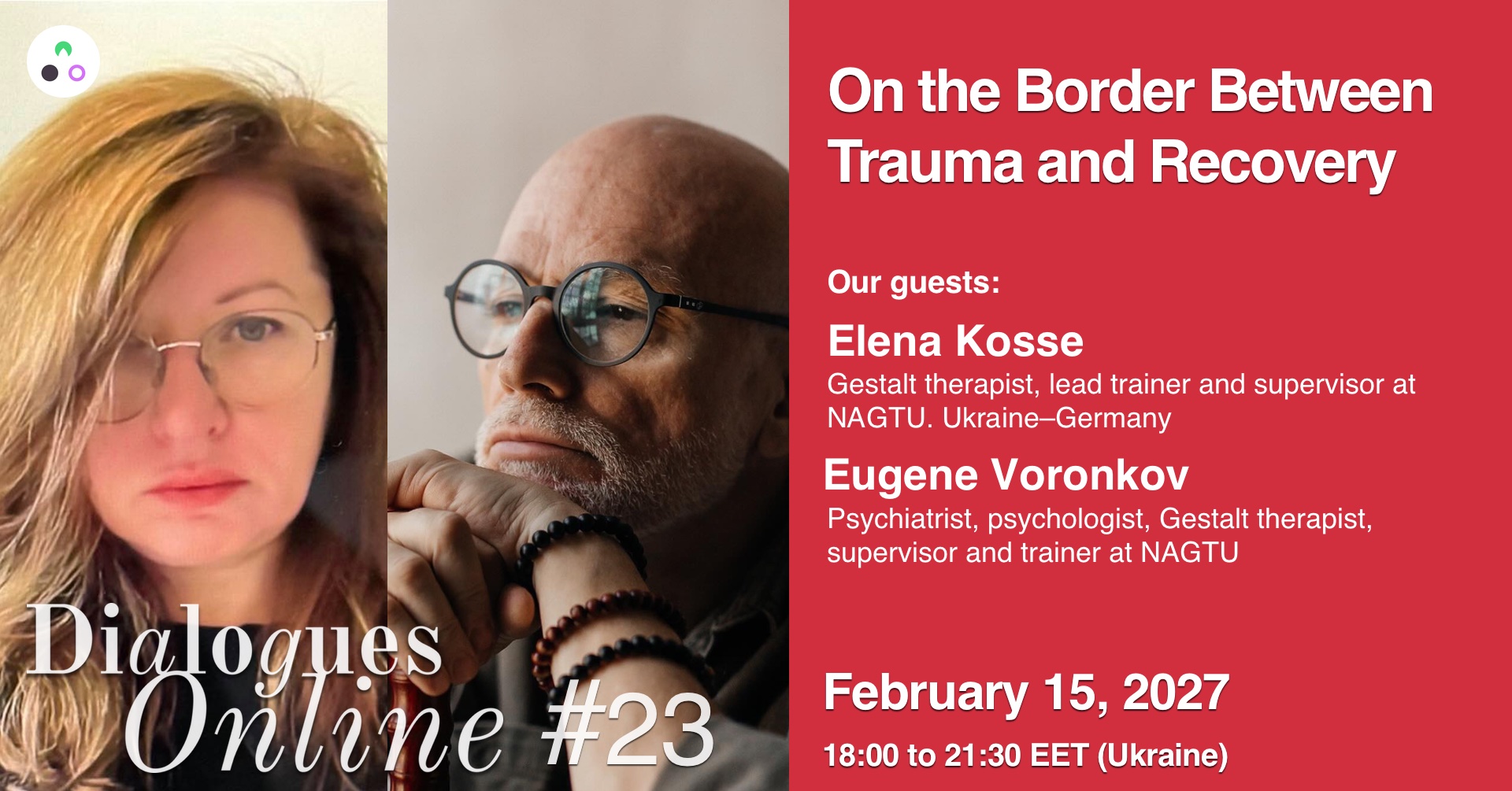
Topic: On the Border Between Trauma and Renewal
The situation we are living through can certainly be described as a psychologically traumatic pandemic.
If we were to map out a continuum of the manifestations of psychological trauma, ranging from mild to severe, it would look like this:
- Psychological discomfort or a stress reaction is a natural, normal response.
- An acute stress response.
- Adjustment disorder—a prolonged adjustment crisis.
- PTSD, CPTSD. Possible variants include post-traumatic psychogenic depression, dysthymia, and other psychogenic psychoses.
- A lasting change in personality resulting from severe psychological trauma.
In all cases, there are appropriate ways to provide assistance to address each of these clinical phenomena and their immediate manifestations.
Of course, recovery is often impossible without psychological support—and, in severe cases, pharmacological treatment as well.
To embark on the path to recovery and see it through, you need to work closely with a professional and follow well-thought-out recommendations.
It often takes years, but eventually the desired results can be achieved—and may even lead to the phenomenon of post-traumatic growth, which involves the development of new qualities and abilities, exceptional resilience, and sometimes even certain unique capabilities that a person who has survived a severe post-traumatic crisis may develop.
Dialogue Participants:
- Elena Kosse, gestalt therapist, leading trainer of NAGTU, leading specialization “Crises and traumas”, supervisor of NAGTU. Ukraine – Germany
- Evgeny Voronkov, psychiatrist, psychologist, Gestalt therapist, supervisor and trainer at NAGTU. Author and facilitator of the “Advanced course on psychiatry for psychologists” and clinical supervision groups for psychotherapists.
- Olga KadyshevaOlga Kadysheva, psychologist, crisis psychologist, Gestalt therapist, leading trainer of NAGTU “Ukrainian Gestalt Institute”. Ukraine – France
- Mikhail Slutskin, psychologist, accredited Gestalt therapist, and supervisor at the Ukrainian Gestalt Institute (NAGTU). Ukraine – Germany
- Mikhail Baitalsky, philosopher, Candidate of Philosophical Sciences, EAGT-accredited Gestalt therapist. Ukraine – France
When: February 15, 2027
Meeting duration: 3.5 hours, from 18:00 to 21:30 (Kyiv time).
Event plan:
Introduction: 5 minutes.
Speakers’ dialog: ~1 hour.
Questions on the topic: 15 minutes.
Break: 15 minutes.
Discussion in working groups: 55 minutes.
Questions and exchange of opinions in a common group: 1 hour.
Что такое Диалоги Онлайн?
Dialogues Online is a space for collaborative reflection on what is most important in the ongoing crisis. Dialogues Online is a continuation of the “Dialogues in Toulouse” held in May 2023 in the framework of the school for Gestalt therapists for intercultural exchanges.
For whom:
▪️ For practicing psychologists with a Gestalt approach and other areas of psychology and psychotherapy.
▪️ For students in relevant programs.
▪️ For anyone interested in psychology and philosophy.
▪️ For those seeking themselves and their place in a changing world, for those who are curious, sensitive, changing themselves, open to new experiences and resources.
For: Education in psychology, philosophy and anthropology; developing a culture of dialog.
How: by creating a collegial interdisciplinary field for reflection in dialog and polylogue.